
Biden Broke What Trump Fixed. Workers Are Still Paying the Price.
WASHINGTON, D.C. — In April 2020, the Trump NLRB fixed a broken rule. In July 2024, with less than six months left in office, the Biden NLRB broke it again. Workers across the country are still living with the consequences — and they have a name for what's being done to them: blocking charges.
What They Are and How They Work
Under the National Labor Relations Act, when workers gather enough signatures to trigger a decertification election, the NLRB is required to hold one. Full stop. Not "hold one unless a union objects." Not "hold one after allegations are resolved." Hold one.
The blocking charge policy inverts that. When workers file to remove a union, union officials can file an unfair labor practice (ULP) charge against the employer, alleging misconduct, no matter how speculative, unrelated, or unproven, and freeze the election entirely. Workers sit in limbo. There is no deadline. Investigations can drag on for months. Sometimes years.
The NLRB's own data shows ULP charges now take over 400 days on average to reach a complaint. The blocking charge policy doesn't just delay elections — it buries them.
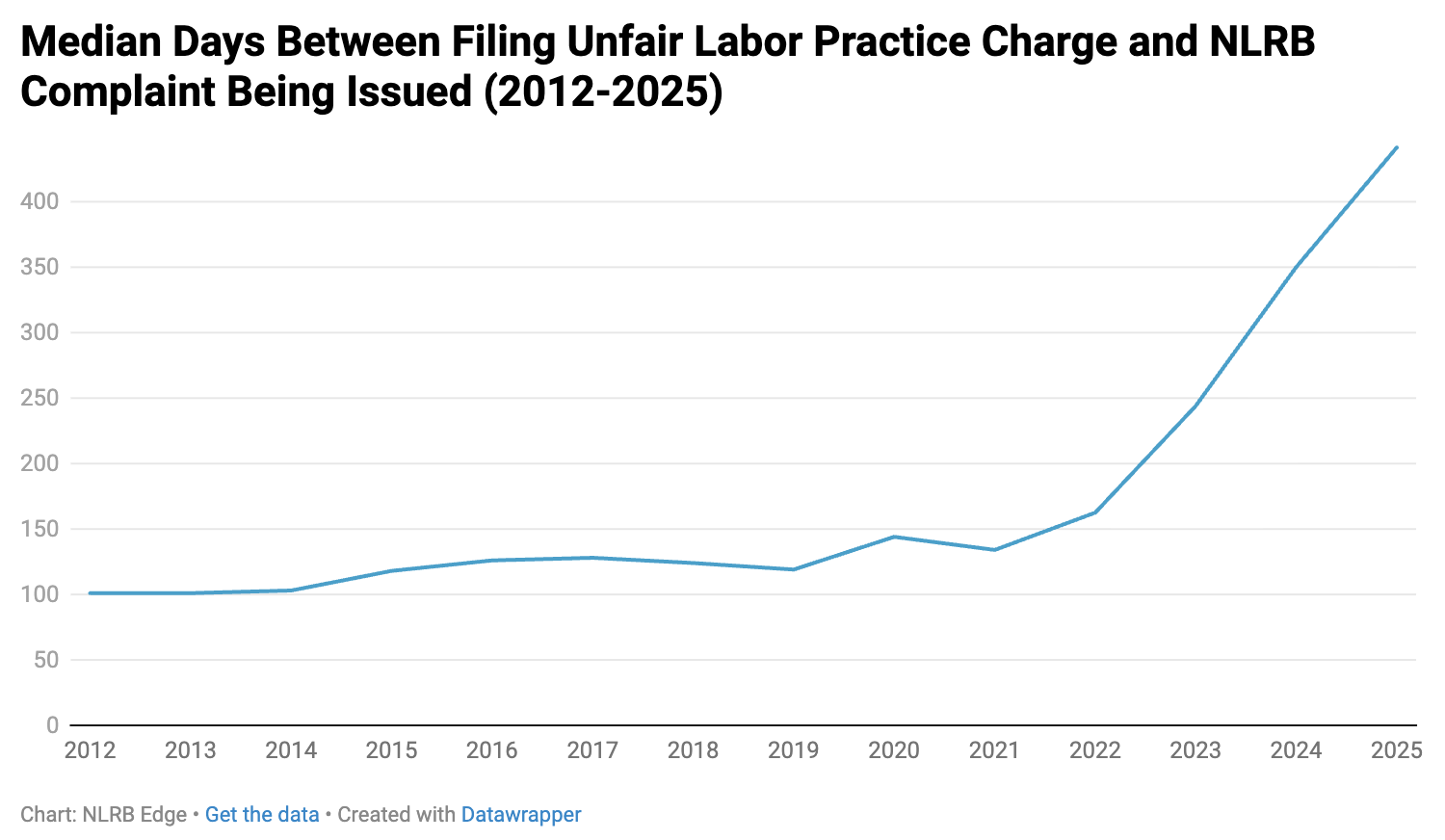
Trump Fixed It in 2020. Biden Reversed It on the Way Out.
In April 2020, the Trump NLRB enacted the Election Protection Rule, preventing pending ULP charges from blocking elections outright. Workers could vote. Outcomes could be held pending investigation if needed. The vote itself couldn't be weaponized away.
In July 2024, the Biden NLRB scrapped it. The ironically named "Fair Choice–Employee Voice" Final Rule — effective September 30, 2024 — handed that power back to the unions. Regional directors could once again freeze elections indefinitely the moment a ULP charge landed, allegations unproven and uninvestigated. As one legal analysis put it, the rule "gives labor unions greater leverage and rights by eliminating opportunities for employees to vote and make their own choice on collective representation."
The lone dissenter on the Biden NLRB, Member Marvin Kaplan, called the rule change unnecessary and argued the majority "rescinded it not because they must, but because they can," warning it "improperly prioritizes the interests of unions over that of employees." The Washington Post editorial board agreed, calling the policy "boneheaded."
The Playbook in Practice
The pattern is unmistakable: blocking charges get filed when unions fear a vote they're going to lose — and dropped when the game is up. It doesn't matter which union. When workers raise their hands to leave, the institutional reflex is the same: reach for the procedural weapon and freeze the clock.
The union filed. The workers waited. The union ran.
In Fresno, California, ready-mix concrete drivers at CalPortland filed to remove Teamsters Local 431 in October 2025. The local immediately filed blocking charges. The NLRB froze the election. In early January 2026, with the new NLRB Board seated and the writing on the wall, the local quietly dropped its charges. Workers voted 9-7 to remove the union on January 29. "The workers had to wait for the union to drop its own charges just so they could have a chance to exercise their right to vote," said National Right to Work Foundation spokesperson Jacob Comello.
The Teamsters have long claimed to be the union that puts workers first — but when Local 431 filed unproven charges to freeze a vote its own members were demanding, it proved the point that applies across the labor movement: even unions that talk the right game will choose institutional power over worker choice when their grip is threatened.
Eight months. Unsubstantiated charges. The union ran.
In Monson, Massachusetts, packaging associates and delivery drivers at Holistic Industries filed to remove United Food and Commercial Workers (UFCW) Local 1459 in June 2025. Their petition carried well more than the required signatures. The UFCW responded in July by filing blocking charges alleging employer misconduct that, by the NLRB's own eventual assessment, was unsubstantiated and unrelated to the workers' desire to leave. The NLRB froze the election for months. Workers filed their own Request for Review, arguing the policy should be overturned. Then, in February 2026, eight months after the original petition, the UFCW disclaimed interest and walked away rather than face the vote. "There's no reason that UFCW bosses should have been able to delay this result for the better part of a year," said National Right to Work Foundation President Mark Mix. Eight months of workers' lives, held hostage by charges the union couldn't defend.
Workers ready to vote. Union fires a barrage. Workers are still waiting.
In Spruce Pine, North Carolina, miners at The Quartz Corp. gathered more than enough signatures to trigger a decertification vote. The United Mine Workers responded with a barrage of ULP charges — some filed before the petition was even submitted. NLRB Region 10 froze the election without identifying which allegation justified blocking or how any of it interfered with worker free choice. Worker Blake Davis has filed a formal Request for Review with the full Board in Washington, arguing that allowing a self-interested party to unilaterally block elections "offends the entire structure and purpose of the Act: employee free choice." Those miners are still waiting.
The Board Has the Authority. The Moment Is Now.
The evidence is unambiguous. Across industries, across states, across union affiliations, the blocking charge policy produces the same result: workers who have clearly exercised their legal right to seek a vote are denied one — not because of proven misconduct, but because the policy hands union leadership a procedural weapon that requires no proof, no deadline, and no accountability.
The NLRB's own blocked cases docket makes the scope undeniable: as of today, 32 representation cases remain frozen across 16 states — hotel workers in Minnesota, nursing home workers in New Jersey, distillery workers in Kentucky, healthcare workers in Ohio. Some of these cases have been open and blocked since 2006. Nearly two decades. Workers who filed valid petitions before the iPhone existed are still waiting for a vote that federal law says they are entitled to.
President Trump ran on restoring worker freedom and cutting through the regulatory overreach that rigged the system against ordinary Americans. His administration has delivered on that promise in agency after agency. With the confirmation of Board Members Scott Mayer and James Murphy, the NLRB has the tools to finish the job. The courts are already moving in the same direction. The Sixth Circuit and the Eighth Circuit have both rejected Biden-era NLRB overreach, affirming that worker choice, not union institutional power, is what the law is designed to protect.
Mayer and Murphy are in a position few policymakers ever occupy: the authority to make a lasting difference is fully within their reach. As former NLRB Chairman Marvin Kaplan wrote in Bloomberg Law, a 2-1 majority is sufficient to codify reform through formal rulemaking — with full transparency, public comment, and judicial review built into the process. This is exactly the kind of durable, principled policymaking that defines a legacy and delivers real results for the American people.
The workers in Fresno got their vote. The workers in Massachusetts got their vote. The miners in Spruce Pine are still waiting — and so are the workers behind every one of those 32 open cases, some of whom have been waiting since before most of today's workforce entered it. The authority to end this is in the Board's hands. American workers are counting on them to use it.